Legal at the whistle, then anywhere
Legal at the whistle. After that, anywhere.
Six players must be in a legal order at service and are then free to move, which is why the game looks chaotic and is not.
The rotation is a snapshot, not a sentence
The referee whistles. The server steps to the line. In that frozen half-second, every player on the court must be standing in the right place — and then, the moment the server contacts the ball, none of that matters anymore. The six players can sprint to whatever positions their system demands, stack in the corners, switch sides of their own court, bunch around the setter. What looked like a rigid grid has already dissolved. This is one of the genuinely useful things to understand about volleyball: the rotation governs a single instant, and life after that instant belongs to the coaches.
The rotation is the fixed sequence in which a team's six players cycle through the right-back, right-front, middle-front, left-front, left-back and middle-back positions. Every time a team wins the right to serve — what older scoring systems called winning a side out — each player moves one position clockwise. The player who arrives in the right-back spot becomes the server. That cycle is permanent for the set; you cannot rearrange it mid-match. What you can do, freely and immediately after service, is move.
What the rule actually says
The FIVB ↗ rule is precise and narrow. At the moment of service contact, each player in the back row must not be standing level with or in front of their corresponding front-row neighbour, and each player must not be standing as far left as the player to their left, or as far right as the player to their right. In plain terms: the order must be readable on the court. The right-back player should be to the right of the middle-back and closer to the right sideline than the left-back. That is all the rule demands. It says nothing about how far forward or back they are, nothing about proximity to the net, nothing about where anyone goes once the whistle has triggered the serve.
When that positional requirement is violated — a back-row player level with or overlapping a front-row neighbour in the forbidden direction — it is called an overlap fault, and the penalty is immediate: a point for the opposition and a loss of serve. These faults are judged at one moment and one moment only. An overlap fault cannot happen during the rally. It exists only at service contact, which is why top teams can stand in formations during the pre-serve moment that look borderline to the naked eye and still be completely legal.
The gap between legal and where everyone wants to be
The interesting question is why that gap exists, and what teams do with it. The answer is that six players in a strict rotational wheel would produce two significant problems. The setter would only be in the front row for half the rotation, severely limiting attacking options. And key attackers would spend turns in positions where they can contribute very little. The rules create a fixed rotational order but deliberately leave room for teams to paper over it through positioning.
The dominant system for managing this is the five-one — one setter, five potential attackers. Because the setter needs to reach the right-front or right-back area to set from (depending on the rotation), the whole pre-serve arrangement is designed to put the setter close to where they need to sprint the moment the whistle sounds. If the setter is legally standing in the left-back position, the team will place them as far right and as far forward as the overlap rules allow, meaning they have the shortest possible run to the setting zone after service. The front-row players, meanwhile, shift toward the left to widen the attack angles. All of this happens in roughly the time it takes a ball to travel from the server's hand to the far side of the net.
The movement after serve is also how teams hide their libero in the back row, pulling the player they replaced forward and out of the way. The libero, in their contrasting jersey, can pass from anywhere in the back-zone once the rally begins; the mechanical choreography of service contact is how the roster ends up looking, during live play, quite different from the strict rotation order written on the scoresheet.
Why it doesn't look chaotic
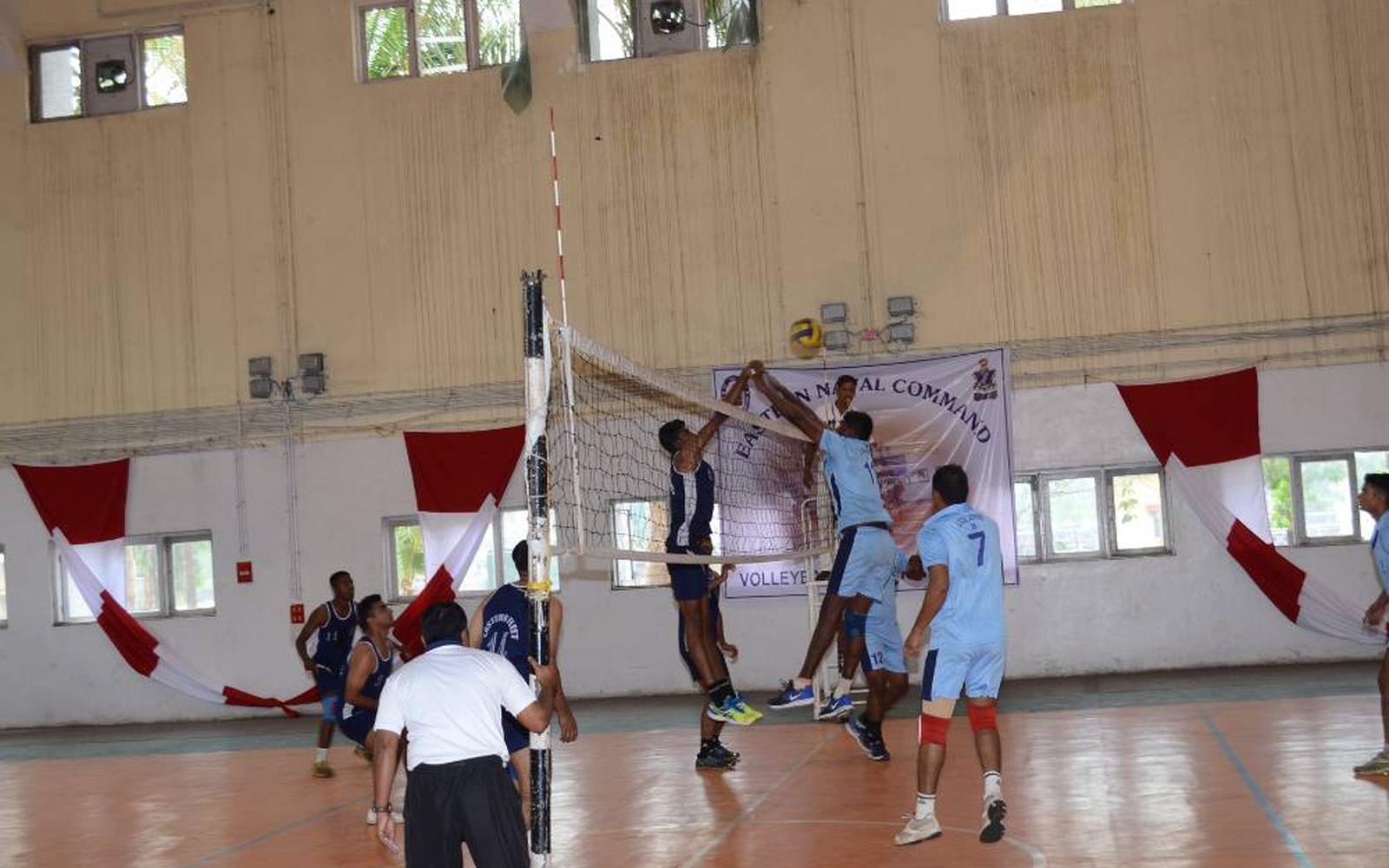
Watching a high-level match — in the Italian Serie A1, Poland's PlusLiga, or the Brazilian Superliga, leagues where the best professionals actually spend most of their careers — what you see in the seconds after each serve is coordinated movement that the untrained eye can read as disorder. Players cross paths, switch sides, funnel toward the net or away from it. Seasoned observers of international volleyball, including those who follow the FIVB Nations League ↗ through the summer window, will recognise a team's system partly by how it moves in that post-serve second, before the first contact.
It is not chaos because every move is rehearsed. The rotation order determines who serves and who is legally positioned where at that whistle. Everything after it is structure built on top of the rule's single constraint. The six-person rotation is less a playing formation than a scheduling mechanism — it tells you who serves, and it tells you who gets to attack from the front row. What it does not tell you, and what the rule does not restrict, is where anyone actually plays volleyball.
Reading it from the stands
For a viewer working out what they are watching, the useful habit is to notice the rotation number the commentators reference — teams are said to be "in rotation three" or "rotating out" a particular player — and to watch what happens in the half-second after serve contact rather than during the pre-serve formation. The pre-serve picture is legal compliance. The post-serve picture is the actual system. Once a team's setter location becomes predictable to you, the whole structure follows: you can anticipate which side has two front-row attackers and which has one, you can see where the libero will surface, and you can watch the jump server across the net and understand exactly which defensive arrangement they are trying to exploit.
The rotation is a snapshot the referee takes once per rally. After that whistle, the game belongs to the players.
That cycle is permanent for the set; you cannot rearrange it mid-match.

Read next